
Finding the Cross
Love and the Will of God: Caring for my Mother with Glioblastoma

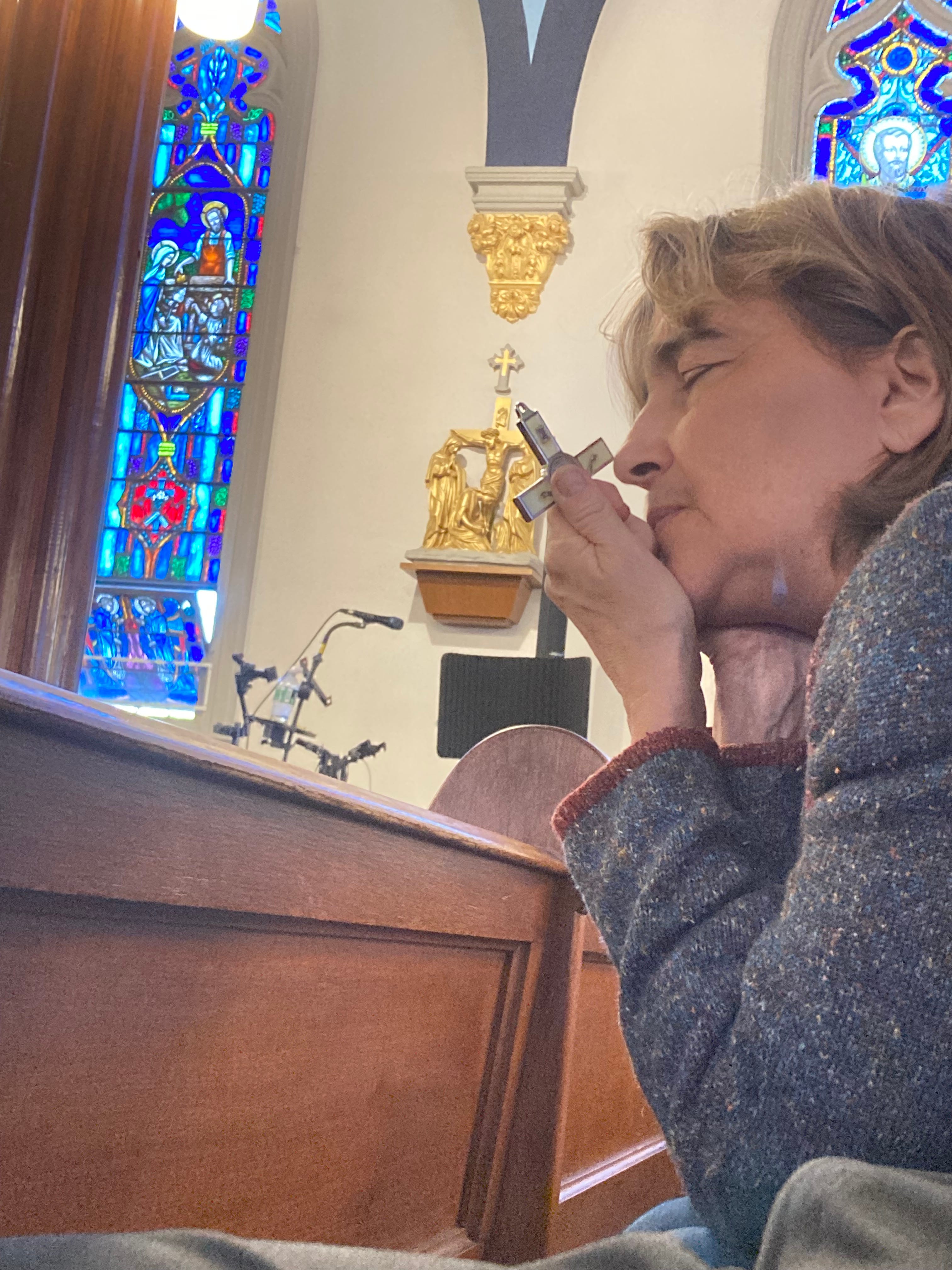
One of the central mysteries of Christianity is the mystery of the cross, of Christ’s redemptive suffering for the world. It is part of the Christian response to the Problem of Evil, one of the biggest stumbling blocks to faith that exists. But the Christian experience adds yet another layer of mystery, when in the lives of the saints, suffering itself, or each person’s cross, becomes compatible and even deeply intertwined with a sense of peace and joy.
The last chapter, “Finding Joy,” covered the months between August and October with an emphasis on that joy: the unexpected level of happiness and simplicity that Mom was able to find and spread to those around her while she was sick. This chapter covers roughly the same period, focusing on Mom’s own experience with the cross—both her own and that of others— ending with what looked to us, at the time, like her last days.
Her story, as ever, was mysteriously connected with the lives of those around her. August and September of 2024 included not only Mom’s 40th wedding anniversary and her birthday, but also the death of Leo McDonald, the 10 year old boy whose young mother, Emily McDonald, Mom had been a friend and older confidant to for years. Leo had been diagnosed in November of the previous year with another form of terminal brain cancer, and his diagnosis shook Mom deeply, long before she received her own. She would often ask for prayers for the McDonald family, and when she was sick she would linger over their picture in her prayer book.
As for herself, Mom would insist that she barely suffered. She was always intensely grateful for what she saw as one of the greatest blessings of her cancer: the fact that with all her neurological symptoms, the tumor’s progression caused her almost no physical pain. She was also continually astounded by the level of care she received from her loved ones, not just those living with her but also my grandma and siblings that would call or come for visits. Her contemplation of her own illness in prayer was not just about her own losses or struggles, which she did experience, but also about her unworthiness in the face of her own blessings. The line she had written on the notecard months or years earlier was coming true: “To be a child of God is to enter ever more deeply into the mystery of your own nothingness and of God’s infinite power, mercy, and personal love for you.”
As September progressed, the sibling group chat (“Sibling Mom-Com”) chronicled a slow but steady decline. But at the very end of the month, Mom had one of her sharpest downturns, and started manifesting behaviors more like a dying person: the right side of her body shut down completely, so she needed help with the bathroom, she needed a wheelchair to get to the kitchen to eat, and she was unable to eat by herself. But even while she needed more and more help dressing and getting out of bed, she still got to mass in the morning almost every single day.
Little Leo died on September 25. Mom’s decline accelerated shortly afterward, in the early days of October. Then on October 8, the day of Leo’s funeral, for the first time she didn’t wake up in the morning. After a series of dramatic events, Mom was put on hospice. Everyone thought these would be her last days.
August 24
The same day I brought Mom to St Joseph’s for adoration and sang with her on the car ride back, I also asked her about Emily McDonald: “Mom, what’s your best dream for Emily McDonald?”
With a look of suffering she responded, “Oh, Emily McDonald! My best dream for Emily McDonald… is that she have peace. She has suffered so much, so much. Even before this, she has suffered. God asks so much of them!” She went on to talk about how she believed God had great things in store for them, and he will do great things for her and through her. The following I got on a recording:
“But it will happen. She will see it. It’s not possible that she will not see it. She’s trying, as much as she can. Great, great things for her, great things for her, and her family.”
September 7
That afternoon Mom woke up from a nap as I was cleaning the kitchen, and I made her some lunch. She had to take some more supplement pills, but she was a little dejected and did not feel like taking them.She felt bad or flabby in her stomach, and thought that taking too many pills would be bad, but she was really struggling to express herself. I talked about taking them or not taking them… but eventually tried to get back to her favorite topic.
Me: “Mom, what is the most important thing? Do you remember the most important time of day, what would you say is the most important thing?”
She looked confused and tired, and didn’t know what I was referring to, maybe thinking I was still talking about meds. “The most important thing…” Eventually she said no, and asked me what it was.
Me: “Well, I think we would say it’s God…”
Mom: “Oh… yes… that’s true…”
Me: “So I guess it doesn’t matter much if you take the pills or don’t take them, as long as you do it for God?”
I didn’t have to explain myself much more. Soon she looked a little more centered, and decided to take both big yellow supplement pills. She looked at them each distastefully as she picked them up, but when I asked if she was offering it up for someone, maybe the Father (the Prelate of Opus Dei), she said yes, and swallowed it right away.
September 8:
Mom had been losing a lot of her vocabulary recently, and struggling to remember things. After Mass, Dad finally asked mom if she knew his name, if she knew who he was. She looked at him, with her characteristic little frown, but all she could say was “You? — you’re mine…”
I came up to them while she was rubbing his knee and saying “mine… my only…”
Eventually when we said it rhymes with “all” she got around to “Paul”. She said it slowly, stuttering a little, like it was a very strange or foreign word.
She had a very bad crash in the afternoon, and started speaking gibberish whenever she would try, with a lot of effort, to say something. My dad told her at some point not to worry, she didn’t have to try so hard… words were overrated.
September 9:
I was putting Mom to bed after another hard day, and she was asking me why she had so much trouble speaking — why such bad days all of a sudden?
I told her the easy answer was that the dosage in her medication was just a little bit off, and we were trying to adjust it to make her feel better. The hard answer — and I paused to make sure she understood — was that eventually the tumor was predicted to win over whatever medications she was taking, and she would have to lose her speech then regardless. She was nodding like she understood. I asked her how she felt about that.
She raised her hand with a little shrug and shook her head helplessly. “God… (gibberish word).” Then very clearly: “God knows. I don’t know.”
I read her some writing of St Josemaria while she was lying down ready to fall asleep, and she made little noises of affirmation at a passage that had to do with generosity and giving to God what we have — that even though He doesn’t need us, He still wants to rely on our littleness to accomplish His will.
September 13:
At dinner we read a very moving letter from another supernumerary (married member of the Work) who had suffered a lot in her life, and had gone through incredible pain having to do with surgeries and brain trauma. This is a fairly common occurrence: that people will open up and share their struggles or sufferings, or how they’re praying for Mom, and she will in turn shake her head in disbelief at how good and how strong they are, and how much they have to suffer. She doesn’t seem to count any of her own struggles as suffering, even though in the moment she does occasionally complain of pain or “loopiness,” or losing things. She has a strong sense of being spared, because of her own weakness, so much of the suffering that other people go through.
She spent a large chunk of that afternoon and evening listening to music, some of which my brother Aaron came over to play, and was mostly peaceful and content. But as soon as Aaron left, her body crashed, and she started feeling dizzy and nauseous. She kept saying she felt like she would throw up, and she had a horrible grimace on her face.
When Dad was putting her in bed, he suddenly paused and put his face very close to hers.
“Do you know what I think?” He whispered gently, “I think there’s a lot of grace flowing. There’s a lot of grace in this room.” I couldn’t see her face, but they stayed like that for a very long time.
I had a stomach ache too that night, and when I was saying goodnight to her I told her so, hoping to offer some solidarity. But her maternal instincts kicked in and she was suddenly more concerned about me than herself. She was still grimacing, but I think more for my sake than hers. She stroked my hand, felt my head for a fever, and insisted that I go right to bed.
September 14
After a visit with some non-Catholic friends, Mom looked upset, knowing that they were going through something difficult and that she couldn’t say anything to help, and also that she likely wouldn’t be around for them in the future. She told me, with a look of helplessness on her face, “I have to do what God wants. I can’t… I have to do what God wants.”
September 15
Early on in her illness, I had given Mom a little green crucifix, one which I had bought for myself in Rome several years earlier. Over time she became very attached to it. She would kiss it like a child, or a needy person, and then press it for several seconds against her cheek as if to give Jesus a hug. Often when she didn’t have it on her she’d look around and say “where’s my…” and we’d know what she was looking for.
That morning, after the morning offering I gave her the crucifix to kiss. She kissed it and then looked at it with particular awareness.
Me: “I like that crucifix. It’s good to kiss a crucifix”
Mom: (looking at me) “I — ‘im”
Me: “You are Him?”
Mom nods.
After Mass, our parish priest delivered a certificate of blessing, requested from our pastor — an apostolic blessing from the pope for Mom and Dad’s anniversary, with their name on it.
Mom started crying when she saw it. When I came up and sat next to her she shook her head helplessly and started repeating, as she often did, “so many, many, so so many… so many…” (referring to all the blessings she receives, and the goodness of people).
And then pointing to herself: “I — le-et, le-ess, mess, ness.. sall, mall — sm-all. So bitt, bittle, lit-tle, little, so little.”
Me: “You are little?”
Mom nods. “And s-ess le-ess, every day, every day less. Every day.” She shook her head with a lot of emotion.
That afternoon after prayer in the church, she looked at me very directly and meaningfully as we were coming out and said two words: “with you.”
I did some investigating (“who is with me? With me when, and where?”). I found out that she meant to be with me in spirit or in prayer, while I went to my orchestra rehearsal that evening. I had been telling her about it, and how I was a little nervous for all the music I had to learn for our next concert. She was showing interest in my affairs, as a sign of love.
I told her in the car as we were pulling away, that I had the sense she would be “with me” from Heaven for the rest of my life. “I think we’re actually going to be very much together forever.”
September 16
When I came to wake her up in the morning, I looked for the crucifix to give to her, but she already had it in her hands. She was holding it very tightly and looking at me with a sort of frightened, vulnerable expression on her face. When I sat down on her bed she reached up and grabbed me, pulling me to her chest, so that I could hear her heart beating loudly.
She had had a bad night’s sleep, waking up intermittently with pressure and aching on the left side of her head, where the tumor was. She kept the crucifix with her that morning, holding it tightly all during prayer and Mass.
I took a picture of her with the crucifix and texted Emily McDonald afterward, asking how she was doing. She invited us all to her house the next day, where a priest would come every day to say Mass for their family and for Leo, who was now mostly unconscious, in his last days.
September 17:
We went to Emily’s house for Mass. Mom hugged Emily’s husband Derek, saying “every day, every day, all the time, every day”, meaning how much she was praying for them. She hugged Emily saying “I love you I love you I love you” over and over again. Both times she was in tears or close to tears. The house was very quiet, since Leo’s younger brothers were away. Mom and Dad both prayed over Leo, who did not wake up to any noises or movement.
That evening we called Grandma as usual for the rosary, and we offered it for the McDonalds. Mom shook her head when we told Grandma about Leo, saying “just a little, little baby…”
Shortly afterward, I was finishing up some work on my computer in the kitchen, and Mom passed me while she made her way to the bathroom. I gave her a kiss on the cheek, like we did often to her in my family then, but this time she turned and took my face in her hands and said with a pained expression, “Why? Why?”
It was her pained expression at being “spoiled.” She wasn’t wondering why she had this illness, but why she has such children, who love her and take care of her so much, when so many people don’t have that, when so many people suffer more.
I just reminded her: “Things to be happy about!”
And she said “I know, I know.”
September 23:
While we were walking into the church for prayer that afternoon, Mom was trying hard to express how scared she was at losing her speech, because she didn’t know how she would tell us if she was feeling sick or getting new symptoms. “Can’t—say!” she would say, gesturing to her mouth, and then she pantomimed feeling sick, gesturing to her stomach area. She looked at me anxiously. I couldn’t really reassure her about her speech, so I decided to just redirect her to the pews and let her talk to God about it.
I thought about praying out loud with her, but she looked so intently at the tabernacle, I had the sense my words would only be a distraction. A few minutes later she made a forceful gesture, pointing with her whole hand toward the tabernacle with each word as she said, “You, you, you, you, you!”
Not a peep from her after that.
September 25:
That morning before mass, she leaned over and told me again,
“I know – Him.”
“You know when he’s here?”
“Mhm. I know He’s there.”
In the afternoon we read to Mom messages from multiple people, responding to Dad’s latest email update or reaching out on their own, who were ascribing heroism to Mom. They glowed about how much she and our family are suffering, and how much of an example we are, etc. To some she would listen patiently, but often she’d shake her head vehemently, or make some sound of disapproval. Someone compared her to Ruth Pakaluk, and she was so appalled by it that she remembered it hours later, and got out a news clipping from Ruth Pakaluk’s obituary, having us understand, through words and gestures, that you could only compare her to Ruth if you had never met Ruth.
It seemed true that people thought we were suffering a lot more than we were, and thought we were more heroic than we were, or that Mom had more human virtues than she did. Dad and I were often very moved by what people say, even counting those exaggerations. To her protests though, we reassured her with a lot of good humor that she’s not really the hero of the story, that it’s God’s grace working in people and she’s really not worthy of any of it. That would usually placate her, and to show her assent she would throw up her hands or shake her head in disbelief.
Soon after, we got a call from the McDonald family. Little Leo had died. I overheard Dad telling Mom, and she made a little cry of distress. Then, after a little bit she said something like “but he’s so happy…”
September 26:
We slept in that morning, so the house was very quiet in the morning. I came into the living room and found her sitting up alone, just looking at her crucifix. I felt attracted to the moment, and decided to do my morning prayer with her then, instead of doing the workout I had planned. I just sat next to her on the bed while she looked down at the crucifix in silence, for another 30 minutes.
September 29:
I did the morning prayer with Mom on her bed again, while she looked at her crucifix, laying down this time. About 15 minutes in, unprompted, she said aloud “I have nothing.”
She shook her head a little and waved her hand back and forth across her face. “Nothing.”
I made some sort of comment in agreement, and then she was quiet, looking back at the crucifix.
Later on that morning, reading lots of loving greetings from everyone for her birthday, one stood out which said that Mom, with her illness, was “a treasure in the Work” (Opus Dei).
She said, to our surprise, something to the effect of “I’m beginning to think it’s true.”
When we asked her why, she said the same thing as in the morning: “I have… nothing” and then gestured to her head, or her thoughts. “I — nothing. Not any thing.”
Later I asked her to clarify again, and she picked up her crucifix. She said “I have nothing,” gesturing to her thoughts around her head, and I realized she meant that she no longer used any words at all in her prayer, to say or offer anything to God. “I just look. Just here. Just look, say here, here, here, here, here. That’s it.”
At afternoon prayer, walking into the church, she got very moved, and waved her hand toward the tabernacle. Looking at Him, with a little tremble in her voice and stumbling a little over words, she said something to the effect of, “is anything missing, in God? Nothing. Nothing!”
Then, after a pause, pointing to herself, “Me, me, me. Me, peres — peresnal — personally no.”
Sitting down: “Oh God, why, why, why? … except that … you want it. But help me to give it. Help me to do it, as long as I can!”
October 4
This was the anniversary of my grandpa’s death, Mom’s dad, several years earlier. I had woken up that morning wondering if there would be any “communication” of Grandpa from Heaven on his anniversary. Maybe he would give Mom an especially good day, or work some sort of healing in her. Instead, Mom had a very sharp downturn that day. In the afternoon she stayed in bed for hours, much longer than her usual two hour nap, and she was groggy and unaware. For the first time ever, she needed a wheelchair to get from her bed in the living room to the table for dinner. At dinner, she would use her hand instead of her fork, and frequently dropped her food into her lap, with a dazed look on her face. Her right arm hung limp by her side.
My sister Emily had come to visit with her daughter Maia two days earlier, and this was her last dinner with us before they flew back to Washington DC. When Emily had arrived, Mom was having a “good day,” the day when she smiled at Maia all during Mass. But I was impressed by Emily’s serenity in the face of this new downturn, and by the love with which she treated Mom as she stumbled over dinner. I think she even helped to spoon feed her by the end.
October 5
Nathan had left for a trip to Washington, and I spent that morning at the Opus Dei center, so it was my oldest sister Tessie who took care of Mom most of the day, along with Dad. Tessie had flown in with her daughter the day before.
Tessie and I both sent voice notes to the family that evening. Mom was getting worse, and looking less cheerful all the time, “like a grumpy old lady.” The next step, we were saying, would be for her to lose mobility altogether and need a wheelchair for everything. It seemed imminent.
At night I slept downstairs with her and had to help her get back and forth from the bathroom a few times. I developed an image in my head of the walker being the friends in Heaven she was leaning on: on one side, St Josemaria; on the other, her father, or maybe Don Alvaro (another holy priest of Opus Dei). It was a cheerful thought to think of the four of us, and the guardian angels, supporting her on every side so she wouldn’t fall.
I was struck, with all the new developments, by how unaware Mom seemed to be of her own decline. Her physical losses went hand in hand with cognitive ones, so that it wasn’t embarrassing or shameful for her to need so much intimate help, even from her children. I counted it as a grace.
October 7
In the morning, getting her dressed for mass, I thought of Psalm 23: even though I walk through the valley of the shadow of death, I will fear no evil, for thou art with me: with thy rod and thy staff to comfort me…
I wrote down: “In these days it takes more faith to see the beauty of everything, like there’s a shadow of silence and weakness passing over. Most of the time Mom is tired and groggy, not able to form complete thoughts or sentences, and not smiling as easily. Her body is heavy and getting heavier. But if you look directly into her face and smile, she’ll usually return the smile, like an automatic reflex, and it’s just the same as before.”
That afternoon was Leo’s wake. Mom went to the church in a wheelchair, with Dad and me helping her, and we saw many friends from our community who had come out to pay their respects and to console the McDonald family. Many of them were in tears, both at Leo’s death and at Mom’s illness. Amazingly, Emily and Derek themselves seemed very much at peace, even cheerful. I knelt at Leo’s coffin and looked at the picture of him, and remembered vividly Jesus’ words to Martha that “I am the resurrection and the life.” I felt a lot of consolation. I hugged Emily afterward, apologizing that I had forgotten to wear black. She told me “you’re totally fine. There’s a lot to celebrate.” She seemed to feel the same thing I did.
Still, when Mom got home she was dejected again, and didn’t want to eat. Tessie put her to bed after giving her a little massage with a massage gun, and told her “I love you.”
October 8
In the morning I woke up, ready to accompany Mom and Dad to Leo’s funeral at St Marie’s, but I found everything changed.
Dad recounted later how Mom had spent all night tossing and turning, alternately throwing covers off and holding her head saying “Oh God, Oh God!” He had tried to talk to her but she wasn’t awake, and she didn’t calm down until the morning, after he had gotten her to swallow some Adavan.
Leo’s funeral was packed. I went ahead and Dad followed separately, but the whole time he was anxious about Mom, waiting for a call back from her doctor. Eventually we decided to take her to the hospital. Nathan had just arrived back from Washington, and when I drove home from the funeral, Dad had pulled up his car up to our front steps, and my brothers were lowering Mom down them in a sheet. We laid her in the back seat of the car, still unconscious, and drove to the emergency room together. Tessie hugged me before we left and whispered that she was proud of me.
Once Mom was at the hospital, everything was a bustle of nurses, scans and medical procedures to try to figure out what was wrong with Mom. But it was the CAT scan of her brain which changed everything.
After reviewing the scan, the head physician’s assistant came into our hospital room to speak to us. She said based on what she could see, it looked like the tumor had crossed the midline of Mom’s brain, and it was headed at any moment for her vital organs. Given the seriousness and unpredictability of the disease, she said, Mom could really die any day. She asked if we wanted to sign a Do Not Resuscitate form, and suggested the hospital release Mom to go home the next day on hospice. At the PA’s words, Dad collapsed for a moment in tears. Even though this is what we had expected eventually, he was in shock at how quickly it had happened.
We called a family Zoom meeting and explained to everyone the events of the last day. Our best option seemed to be to follow the PA’s advice. Everyone was encouraged to come home as soon as they could. Nathan spent the night with Mom in the hospital. Dad decided that evening to tell our friends and family, with a brief email, the news we had received, in case this really was the end.


