
Chapter 2: Finding Joy
Love and the Will of God: Caring for my Mother with Glioblastoma

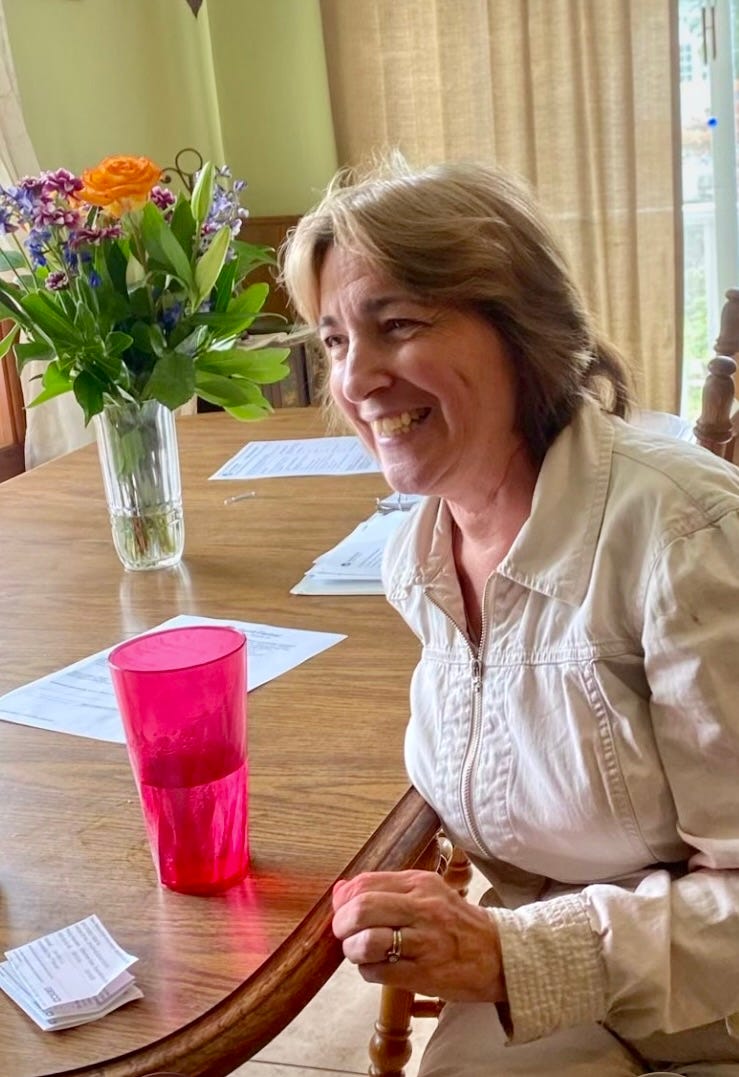
When I came back from vacation to our family home on Park Ave that August to take care of Mom, I had very pessimistic predictions. The change in her from the even-keeled mother I had always known to a confused, childlike dependent was so dramatic, and the initial growth of her tumor so fast, that I expected the rest to follow quickly, that we would likely lose her entirely before the end of September.
But from the very beginning, the illness had a way of taking us by surprise. It was true that despite regular radiation, chemo pills and a strong steroid, the tumor in Mom’s brain was still growing, shrinking her vocabulary and verbal communication, confusing much of her cognition processes, then limiting her eyesight, balance and mobility. But nothing was ever predictable: there were “good days” in which Mom seemed “almost normal”, speaking in full sentences and walking around on her own, “bad days” when she would wake up disoriented, speak gibberish, or feel intensely anxious, and many that days started one way and ended another. Every time she took a downward turn, though, she seemed to pull out of it within a few days.
In the meantime, Nathan, Dad and I settled into our new roles as caretakers at Park Ave. It wasn’t always easy—tensions arose frequently in those first months having to do with personality, communication styles, faith convictions, and sometimes medical choices, as we all adjusted to a new life together, very different from the ones we had left behind. But little by little we built up a new schedule for Mom and for ourselves. We divided up the responsibilities of taking Mom to prayer and mass, making her breakfast and lunch, helping her with exercise and various morning and afternoon activities (like helping her write responses to her many cards, adding to her prayer book, or “translating” her broken English for visitors), and putting her down for her afternoon nap. Every evening Dad and I prayed the rosary with her and her mother over the phone, we ate dinner together as a household, and Nathan gave her a full-body massage before bed. And every day without fail, she would flip lovingly through her “picture prayer book,” a photo album we continually added to, of all her friends and family and their many prayer intentions. With all these activities, the days and weeks eventually took on a steady, peaceful rhythm, even amidst fluctuations.
Mom herself had to work through many internal difficulties in the beginning: intense fear and anxiety about potential future symptoms (especially on “bad days”), sadness at her losses and her own defects, and pessimism about her prognosis. But I witnessed many moments in which, usually inspired by prayer or spiritual advice, she flipped from seeing the worst of her situation to seeing the best of it, and then stayed there, in genuine, simple gratitude. She found joy in those around her, by their encouragement and affection, and in simple things: fresh meals with the produce from our back yard, walks to admire the New Hampshire foliage in the Fall, 70s music, babies… and those around her found joy in her. I watched in awe as the tumor itself seemed to strip away layers of her adult ego and self consciousness, leaving her as trusting and endearing as a little child. In that state, even some of her symptoms, terrible in themselves, just felt silly and sweet. I remember the first time I saw her pick up a fork to use it for a pen, for example, or when she first started confusing pronouns and consonants, and inventing creative ways to tell the time (incorrectly). When that happened, her family would often all end up laughing despite ourselves, and she along with us.
I wrote an email to some of my siblings on August 29th of that year, and recounted a typical anecdote: “I saw Mom off to radiation this afternoon – she was singing songs about sunshine, because it’s such a beautiful day and we walked in the sun. She holds my hand and sings, and then gives such a sunny smile, it’s like she’s a little child. Just before she left she cracked me up by saying (of her shirt) ‘no, this one doesn’t tucker..’ (I had asked if she wanted to tuck in her shirt to her skirt, but it was a dress.) I started laughing so hard and then she started laughing with me. I’m having such a great time.” “She is so good at joy,” I continued later in the same email, “she is so so simple in her current state, and I am learning every day from her to relate to the good Lord as a little child.” It was truly a beautiful time, despite everything. In the midst of daily uncertainties and losses, we all found joy.
August 8:
On my first or second week back, Mom and I tried out a plan of mapping out people for her to pray and offer things up for each day of the week.
On Thursday she spent a while talking to me about her symptoms of that day: dizziness, fatigue, nausea, etc. Then I reminded her on Thursdays we pray for priests. She stopped, and a big smile spread slowly across her face. “Priests!” she said, “Now I feel better — because I am thinking about priests, and not thinking about me”
That evening before the rosary, she was lying in her bed in the living room, and with a lot of doubt and fear she was talking about a “new thing” happening, and about how afraid she was of the future. I told her we get grace enough for each day, and not for the future, and that’s what gives us strength. She said with a very pained and kind of desperately exhausted expression: “I need grace.”
After the rosary, as she was going to sleep I asked her: “What do we pray for on Friday?”
She paused and then said, “So many people are so confused—so many people have no idea, don’t know what I know. And if they knew they would be much better than me. So many people don’t know Jesus. I have so much, I know so much. Total free gift.”
August 17:
I was walking down from the third floor with her that afternoon, and I noticed she had been looking a little dejected recently, not very cheerful. Me: “Mom, our smiles are so important, especially now. You know I bet someone could get a soul out of purgatory just by smiling!” Mom: (Thoughtfully) “Yes—and depending on the circumstances I bet you could get a whole bunch out of there at once!” (Starts smiling, genuinely happy at the thought).
August 18:
Mom woke up in the morning feeling awful and having trouble getting out of bed. When I came down to get her up for prayer, with a lot of effort and emotion she said, “Jesus, help me to love glioblastoma, because it is my way. Help me to love glioblastoma, because it is my way..
It helps me to say that. I never thought of loving it before today”
Me: “And He is with you..”
Mom: “I know, I know He is”
We stayed there for a while longer and I kept talking to her. I asked her something about her grandchildren, the ones she likely wouldn’t see grow up, and she told me, “I’m not worried aboutthem, because I will know them better.” She explained how her mother “knows” baby Otis and baby Dot, two babies in our family who died prematurely—in her prayer—and that her mom says they have personalities and everything. Mom believed that she would have a special connection to children even after she died, just like Grandma did with those children.
After Mass that morning, Mom’s friend Rachael Armstrong, a young mom she had been praying for, came into the pew behind her and gave her a hug, then took her hands and talked to her softly, looking at her for a long time.
Mom: “I am trying to want it, trying to love it because it is my Way.”
Rachael said that ‘trying to want it’ was doing a lot more already than other people would do in the same situation. She seemed moved.
When Rachael left, Mom looked after her for a few moments and then turned to me, shaking her head, and said “Good things are happening. Many good things.”
That evening Mom chatted very peacefully with my uncle Rick, who was visiting from Cincinnati, and I recorded a long conversation in which she explained what it means for a Christian to “offer something up”. She used her brother Don as an example, whom she had learned suffered frequently from insomnia. He could offer that to God, she said, and the suffering undergone in love could serve as a strong type of prayer to help another person in need. She recounted with excitement how she had told Don, referring to his potential for coredemptive suffering, “you are sitting on a goldmine!!”
Me (laughing): “Then what are you sitting on Mom?”
Mom: (somewhat sheepish) “well… at this moment I don’t feel like I’m sitting on much of a goldmine…”
Rick: “But I’m sure you’re doing the same thing”
Mom: “I am, yes, I am trying to…”
Rick: “…offer it up?”
Mom: (Her voice becoming very soft) “I’m trying to offer it up, I’m trying to tell God, ‘if this is what you want — help me to make the most of it…’”
August 20:
Mom was having a hard morning. After breakfast I was spending time with her on the porch and she started pacing around the picnic table, telling me somewhat anxiously about how the night before she had been thinking so much about all the people who die alone. “So many people, so many people don’t know what I know, don’t have what I have. So many people…”
I tried to redirect her attention to something more positive, so eventually I asked her about Heaven, and about what she expected or looked forward to. She paused for a long time, and looked very thoughtful. “I want to see my Dad.” Her dad had died of cancer some years earlier, in October of 2018.
I also talked about the other people she would see in Heaven, like St Josemaria and maybe Ruth Pakaluk, and our Lady… eventually she perked up a little more. “See, this is my conscious brain now. I’m thinking about what I have. I have so much!”
She also told me another thing she had been thinking about all night: my oldest brother John. She kept on saying he was “so good, so good,” and then expressed to me how she wanted to write letters to him and to all my siblings, telling them how good they were and how much she loved them, before she couldn’t speak anymore. She was very aware of her shrinking vocabulary. We started a Google Doc that morning, and dictating those letters to me became one of her most urgent morning projects for the next two months.
August 22:
Sometime during the week after Mass, Mom had turned to me and told me, “I know He is here when He is here” (in the Eucharist).
She hit on the pew emphatically with the palm of her hand, repeating: “I always know when He is here.”
August 24:
That morning we went to St Joseph’s cathedral for Mass and stayed after for adoration. It was a hard day for her, a day when her vocabulary was small and she was leaning a lot on me physically, or else crouching over at mass and holding onto Dad.
Afterward there was a time of adoration. When the Eucharist was placed in the monstrance she raised her head.
After some minutes we had to go back outside because she had to eat a little and take her medication. When I asked her if she wanted to go back she said yes, “I want to pray more.”
On our way back to the car I asked her what she thinks about, what she says, when she’s praying there, when she “knows He’s there.” She seemed a little confused at the question at first.
“What do I say?… I just say… I know you are here. I know you are here. I am happy, that you’re here. I love you… that’s all I can say…”
On the way home we sang many hymns and she was happy.
August 25:
This was Mom and Dads 40th wedding anniversary. It was a special, full day, with a renewal of their wedding vows after Sunday morning Mass, presents and flowers from the kids, and finally dinner out and a night in the Bedford Inn. Even though Mom had anticipated it with some anxiety, she was blessed with a “good day” that day. My dad even caught a recording of her at the Inn, happily singing some verses (which she still had memorized) from the Tin Man’s song in the Wizard of Oz, “If I Only Had a Brain.”
August 26:
In the evening, Mom and I had a long conversation that Nathan and Dad described as “chatty.” It started after Nathan gave her a massage, when I came in the room after he left and she exclaimed emphatically that she was “spoiled rotten.” We were both sprawled across her bed like two teenagers, her on her back after massage, with her feet propped up against the wall. She said if she died soon she would be “let off easy,” because terrible things were coming in the world in the next few years. But I tried to redirect her attention again. “Mom,”I told her, “when I am alive, and maybe living through some terrible calamity in the world, I won’t need the memory of a mother who was unhappy because she never suffered enough. I would need the memory of your smile, always always a smile.” I told her that’s what the others needed too, all her friends and the people who loved her. When she’s reminded of these things, she accepts them like a child, and often laughs when I tell her something she didn’t think of before.
On my part I told her a little about my struggles to relate to my siblings who didn’t share my Faith, and how God was teaching me to be patient. She told me that she took a lot of consolation from thinking of Grandma Swope and Wurzelbacher (her mom), because they prayed and loved so much—so their children and grandchildren could not possibly be lost. She liked to say emphatically “it’s not possible!” to express her faith, and her trust that God won’t let good things go to waste or good people to be lost. She said she had told God once to take away her children early, if ever any of them might be in danger of losing their souls, and she lost two. The other 9 are alive. She had no fears.
Mom did confess she had the most trouble with Dad sometimes, because he was so active and so positive, and she felt like he didn’t understand her. But we realized together he was right to be positive! There were so many positive things to be grateful for.
At the end of the conversation she looked right at me with a big smile, if she had had a sudden epiphany, and said, “you’re right, you’re totally right. Glioblastoma is my way, but my path is also—joy. I should be very happy.”
August 28:
Driving back from prayer that afternoon, she got very excited and even raised her voice quite a bit, telling me, “God has made everything—PERFECT! Every possible thing I could ever need, everything I could want! There is not one thing, no thing, where I could say, ‘you forgot one thing’, because He didn’t! Nathan does so much, and Tessie, and Paul does so much, and you… And the food and the massage and the good things… it is all, absolutely perfect.”
August 29:
Walking to the car for Mass, she turned to be with a concentrated expression, like she was finding the words for something. I asked her what she was thinking about.
Mom: “Today… today…”
I thought she was going to mention a feast day or a family member’s birthday she remembered…
Mom: “Today… Jesus is coming!”
She gave me a huge, beaming smile, like she was very proud of herself.
Me (baffled): But Jesus comes every day!
Mom: “I know. But He is coming today.”
Sometime in the afternoon before a snack, as we entered the kitchen together she looked up and around and said out loud (to God), “Alright, you’re here, somewhere, I know you are. When was the last time I said thank you?”
September 1:
Walking into the church for prayer and genuflecting with a smile, she said out loud,
“Hell-o! So good to see you here!”
September 2:
Putting on her shoes before Mass, she likes to say “here we go—the best part of the day!”
That afternoon we went to the church again for prayer, talking about something together as we were walking in. As soon as she entered in the doors though, she gave a big sigh and said, “Alright, God — here we are!” Genuflecting, she continued out loud: “I’m so happy that I can be here with you! I hope I can still do it, for a long time.”
After prayer, I went to put a kneeler back in its place and stayed there genuflecting for a few seconds. As I got my bag she came over to me and gave me a big affectionate hug, smiling.
Me: Happy daughter!
Mom: “Yes, there are so many things to be happy about!”
Me: And we’re going to be saying that for all eternity!”
Mom: (Very reflectively) “Wow…”
On the way home, we were reflecting on how she never seemed to lose things or experience symptoms too permanently, she almost always got them back a little bit. It was almost as if God was waiting for something.
Mom commented, “Yes God has been so patient with me. And He doesn’t give me anything, except — things to be happy about.”
September 3:
At prayer before Mass she leaned over and asked me “today—what do we pray?”
She was struggling to remember something. “Pray for the pope, the bishop… for the Father.. the pope and the bishop… and the men. Pray for those men… those men who need me.”
I worked with her for a good while trying to identify who those men were who needed her. Eventually we discovered it was the priests of Opus Dei, whom Fr. John had asked her to pray for the day before when he saw her.
At adoration that afternoon she kept chuckling to herself as she looked at the host. When we came out to walk toward the car, I asked her what she was laughing about. She told me, “What was I laughing about? Well… I just have the best job! I say (in a sing-song): ‘I love God — I want you to be happy — Bless all these people…’ and that’s about all I can do!”
September 6:
We went on a walk, and she started talking about what she wanted to write to her brothers, so they could have something to keep from her. She said it would be very simple, just about how she loved them, and what good brothers they are. I had her talk about each one individually, and she was almost always totally simple and positive about everything. At a few points, things came up that saddened her, or that she disagreed with, but after mentioning them she would always reassure me that those points wouldn’t be in the little letters.
It felt like a very profound lesson: in the end, even though we pray for people and try to help them be better and happier, ultimately we didn’t need to tell them how to change, or make them change. Ultimately we just needed to say how much we love them. I told her that this is what I was learning from what she was saying, and she said “Yes, we don’t worry about it. We just say ‘how can I love them—better’? How can I love him better? And He will take care—of them. It is not possible—that he shouldn’t take care of them. That is what my mother does… she says ‘God’s will, God’s will, God’s will.’ She says, ‘you take care of it!’”
Often, Mom will refer to Mass as “the most important time,” or “the best time” when she can’t remember the word for Mass. A person’s spouse is also their “most important person.”
She started having trouble with her kids’ names, even though for a while she would practice with our pictures every day. Jacinta visited home that afternoon from college in Merrimack and we saw her in the yard with the chickens. Mom looked out the window and said “Oh!”
I asked her if she knew who that was. Was it Dad?
“No” she said, “it’s — that’s (pointing to herself) mine, my baby”
September 12
She went to the Opus Dei women’s recollection that morning with Dad accompanying her, and she spent time with a lot of people, even though she couldn’t say much. She told me later that she was a little annoyed at spending so much time talking though, and so little time praying in silence, which is what she really wanted to do. She went to confession in the confessional, even without being able to say more than a couple of words in a row. My dad was very moved to see it.
Later that afternoon we went to adoration together. She was cheerful again at that point, having gotten over her annoyances of the morning. I told her on the way to the church that I was supposed to meet some of Jacinta’s college friends that evening and tell them about Opus Dei, but that I didn’t know what to say. She said, “well—I can help! I can be—happy!” And she beamed at me.
Me: (laughing) To be happy, is that your way of praying now?
Mom: “Mhm!”
September 22:
I came back from a trip away and found her doing housework, sitting on the floor folding some sheets that had just come out of the laundry. She had her legs stretched out in front of her, and looked peacefully focused, like a little child playing with toys. She looked at me when I came in and smiled, somewhat absently.
Housework was one of the things she could still do—she’d often walk around the house and pick things up to put them away, saying things like “here—here” and “this—not here… this.” It was her life’s work, and the instincts to put things in order stayed strong.
September 29:
This was Moms 63rd birthday. As one of her annual traditions, we made her grandma’s special prune cake recipe, and all her kids surprised her on a Zoom call by showing her they had all baked the same cake for their own families! She was delighted.
After dinner we had a dance party, DJed by my Dad’s friend who came over with special speakers. Mom danced the night away… her only regret, which she was still able to laugh at, was not being able to remember every word of her favorite songs, as she always used to. “You do it!” She told my dad with a giggle as she danced with him, “I can’t do it!”
October 1:
Mom had a marked improvement in her health and speech over the course of a week or so, and was able again to pray the rosary out loud with us… for the most part. There were times she would try to start a Hail Mary, but go off and start a different prayer instead, like “have mercy on us” or “pray for us oh Holy Mother of God…” Dad, Grandma and I would wait for her to finish, and then start her on an actual Hail Mary, but she said everything with such simple certainty that her mistakes would make me laugh. When we tried to correct her once by saying “Hail…” and she launched into the “Hail Holy Queen,” I couldn’t contain myself and keeled over laughing onto the couch. Mom and Dad started laughing too, so it took us a while to get back on track.
We described the scene to Jacinta later, and she started laughing too. She gave mom a hug and said “you just bring people so much joy!” Mom snuggled into her and said something very jumbled, like “That’s why they so, many much, round, here, much much.” But then she waved her crucifix in her hand and I was able to translate for her (laughing incredulously), “That’s why He keeps you around so long?”
She responded with her typical “mhm!”
October 3
She was groggy and tired in the morning at Mass, but my sister Emily had come to visit with Maia, her one year old. Mom could never resist babies—she ended up gazing at her happily for most of the Mass, smiling.


Upcoming chapters:
Finding the Cross
Love and the Will of God
Finding the Way Forward
Finding Mission
Finding God